Joe and I watched 6 Pipistrelles slalom around the apple trees in the front garden. No camera handy so I’ll have to fall back on memory 🙂
Oystercatcher (Haematopus ostralegus)
September 3, 2010 by
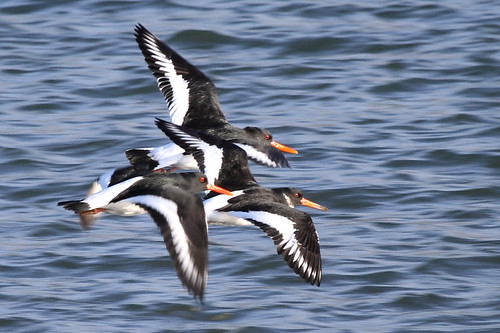
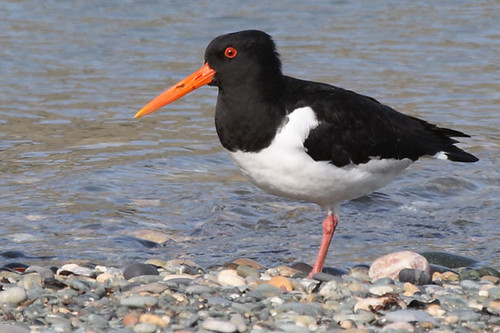
Thanks to Aneurin Owen both for the inspiration for this post and for the Scientific name. Once you start getting into taxonomy, you start dropping these arcane species names into conversations hoping to look erudite (I probably don’t, but that’s never stopped me before). Tonight. for the first time ever and without any prompting, I was asked the common name for Haematopus ostralegus. I got as far as working out there was a reference to blood (haema) but that was it. Bah! It’s a common misconception that scientific names a re Latin but there’s alot of Greek going on in taxonomy and this species’ name literally it means “blood footed collector”.
To be fair there’s a lot of binomial nomenclature out there to memorise. This is the system of identifying every organism on earth by Genus and Species, created by the Father of Taxonomy, Carolus Linneus. It’s just a shame I dropped the first ball thrown to me, which incidentally, is the reason I failed to get into the house cricket team at school. No second chances at public school.
Anyhoo, Oystercatchers! They remind me of cartoon snowmen with a particularly impressive carrot for a nose, or bulked up smaller waders, wearing several overcoats and a partial Groucho mask. They have an unmistakable squeaking alarm call and aren’t at all shy about using it. Unless you’ve got good field craft, this sound, along with a spectacular white flash of the trailing wing edge, as rapid wing beats propel their equally spectacular white rump away from you, are the the best you can hope for.
Their common name is actually a bit of a misnomer, as although physical size and powerful bill mean they’re one of the few waders actually capable of opening an oyster, smaller molluscs like Mussels and crusatceans, even earthworms, form a major part of their diet.
Aneurin Owen
Buzzard (Buteo buteo)
September 2, 2010 by

During the 1940s and ’50s the use of pesticides badly affected Buzzard numbers by reducing their ability to reproduce. The withdrawal of these chemicals in the ’60s along with a significant reduction in illegal killing by gamekeepers, led to a gradual re-population across the country.
These days it’s our most common raptor, the naturalist’s name for a bird of prey, and over here in the West they’re extremely numerous, approaching their maximum breeding density of around one pair every 1.2 miles.
I knew they hunted a variety of prey apart from their usual prey of voles, as I’ve frequently seen them standing around in muddy winter fields, often in small groups, hunting earthworms. You can see by the above photo that a Jackdaw (Corvus monedula) is a much larger proposition than either worms or voles, and although I didn’t expect them to be eating something this big, according to a recent Norwegian study they often target medium sized birds. Indeed this study recorded them feeding 10 Jays (Garrulus glandarius) and even a magpie (Pica pica) to their young!
All of a sudden, the relentless mobbing behaviour, where individuals of a certain species cooperatively attack or harass a predator, made a bit more sense to me. I always particularly wondered why Corvids (crows and their allies), so often on the receiving end of mobbing themselves, bothered to hassle Buzzards. But if they’re a legitimate prey species themselves, I suppose it’s a smart evolutionary strategy.
Mobbing also seems to play an important part in teaching juvenile birds about predatory species, as well as making it impossible for the predator in question to mount any kind of sneak attack. My hens do something similar whenever a Sparrowhawk (Accipiter nisus) tries it’s luck by hiding in the Holly tree in our side garden, hoping a Tit or Finch will hop in for dinner. They all race over and cluster around the base of the tree squawking, clucking and generally making a lot of noise. In the face of all this hysterical racket the Sparrowhawk invariably gives up pretty quickly and if there ever were hen chicks around to witness it, I’m sure they’d get the picture too.
Rove Beetle (Tasgius ater) not (T. melanarius)!
September 1, 2010 by
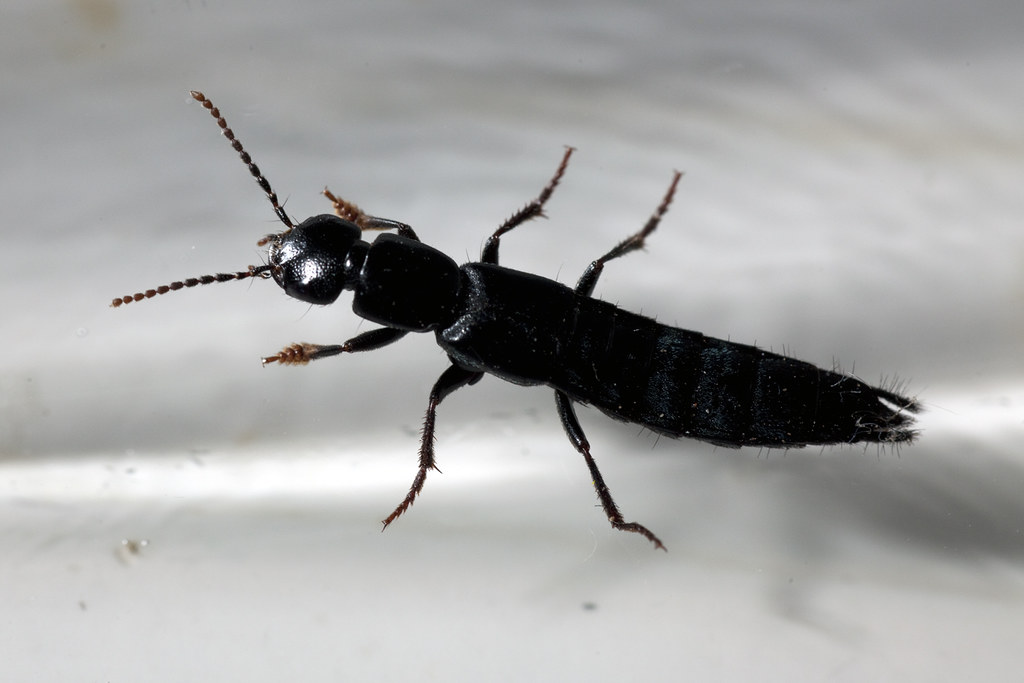
This one just wandered under our back door last night. I could do with a few more taking this kind of initiative, or else I may find myself in the middle of winter with no archive species to add to the blog.
Rove Beetles (Staphylinidae), are an ancient and vast family of beetles. There are over 46,000 species, the second largest group in the absurdly numerous order of Beetles (Coleoptera). Fossil rove beetles date back to the Triassic period, 200 million years ago.
Their most obvious distinguishing characteristic is the short wing cases which just cover the thorax, rather saucily leaving much of their abdomen exposed. When threatened, some, T. ater included, arch their tail up scorpion-like and it’s thought that they even squirt a noxious chemical to drive the point home.
This particular species T. ater is pretty large as Rove Beetles go, mine being around 15mm, but a tiddler in comparison with Ocypus olens, the Devil’s Coach Horse. My Mum caught one of these in a glass for me to see when I was very little, and this is still one of my earliest insect memories.
Thanks to a very helpful chap named Boris who saw the picture on flickr, I’ve changed this ID from T. melanarius to T. ater. Although very similar, the shininess of this beetle’s head is a distinguishing feature.
Enjoying the last bit of Summe…
September 1, 2010 by
Enjoying the last bit of Summer sun on the banks of the Severn at Minster worth http://twitpic.com/2k7cf0
Mouse Spider (Scotophaeus blackwalli)
August 31, 2010 by


Not to be confused with the Australian Mouse Spiders (Missulina) which are much bigger and very fierce looking, these are however similarly capable of delivering a proper bite, one of 14 species found in the UK thought to be powerful enough to penetrate our skin.
I was once bitten by a Woodlouse Spider, which took my childhood arachnophobia to another level, but I’m over that now. Well almost.
Starling (Sturnus vulgaris)
August 30, 2010 by
Another species I used to see more of. This one’s in real trouble and now on the red list.
As a schoolboy waiting for my bus in the centre of Bristol, the increasingly dark nights following the start of the new school year used to be made slightly more bearable by the giant flocks of Starlings which wheeled overhead before roosting on the surrounding buildings.
As a young urban bird watcher, this species was pretty much guaranteed in any garden or park probing the grass for insects or squabbling for food on the bird table. I certainly took them for granted, though always enjoyed seeing them for their iridescent plumage and characteristically boisterous behaviour.
Gradually and without me even really noticing they became somewhat less ubiquitous and when I moved away to college in Reading, I supposed that they just weren’t such a common species that far West. In truth, habitat and invertebrate prey loss through changes in farming practices, the fetish for new build housing and a general tidying away of favoured nesting places, has lead to a drop in numbers across Europe. In the UK, they’ve declined by over 66% since the 1970s.
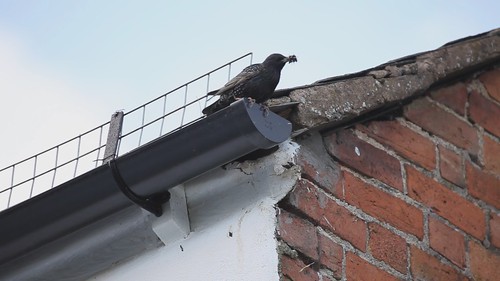
This spring, I was therefore particularly pleased to discover that the scrabbling noise in the roof directly above our bedroom window was down to a pair of Starlings, who’d excavated the old House Sparrow nest behind the gutter.
This video was taken a few days before the chicks successfully fledged and you can hear them shrilly welcoming their parent’s beak full of still wriggling insect goodness!
Common Shore Crab (Carcinus maenas)
August 29, 2010 by
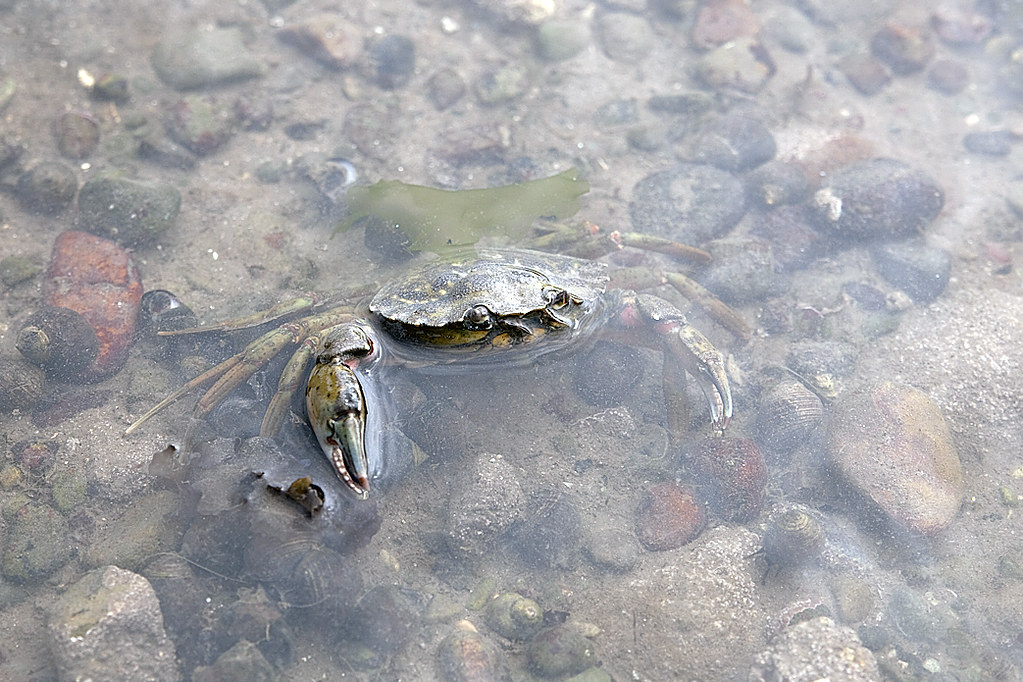
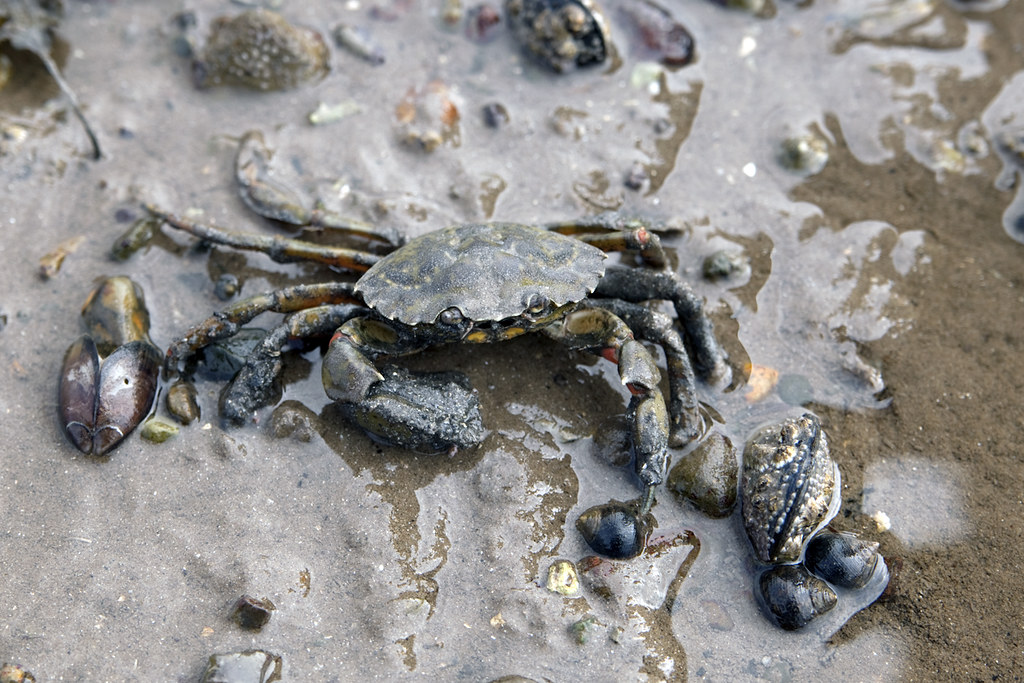
Continuing the theme of invasive species explored elsewhere in the blog, the Common Shore Crab, a native of British waters, has been recorded on almost every other continent.
World domination aside, I have very fond memories of this species. As a lad, each summer we used to take day trips to Sand Bay, a stretch of the north Somerset coast just north of Weston Super Mare. My Dad had spent some years of the second world war living there with my Gran to avoid the Luftwaffe’s bombing of Bristol, so the place itself had good memories for him.
Whilst my parents busied themselves having picnics and other dull things, I used to spend my time prising Limpets (Patella vulgata) from the carboniferous limestone to use as bait on my crab line.
Occasionally I’d catch an Edible or Brown Crab (Cancer pagurus) but most of the time, these deep green Shore Crabs made up the body of my catch. Spending time trying to encourage them out of the submerged crevices of rock polls by dangling a line with a morsel of Limpet on it, needs a fair bit of patience and is an excellent way into learning about the ecology of the inter tidal zone.
At the end of the day my catch would be returned to their respective pools, but as I learned more about the other seashore creatures I got less and less comfortable with the requisite Limpet butchery.
Some years later, whilst working for a conservation charity on the island of Flat Holme in the Bristol Channel, I learned a deep respect for the humble Limpet. We marked individuals and their home positions, then moved them to a different part of the beach to demonstrate that they could move considerable distances. I’m still not sure how they navigated back to their original positions, but they mostly did.
Azure Damselfly (Coenagrion puella)
August 28, 2010 by
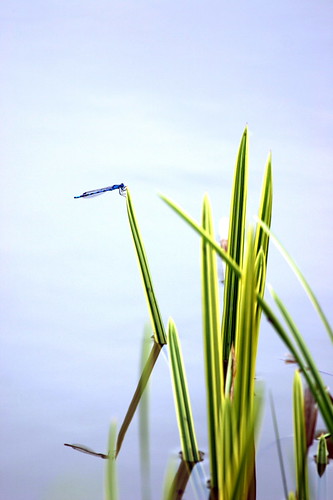
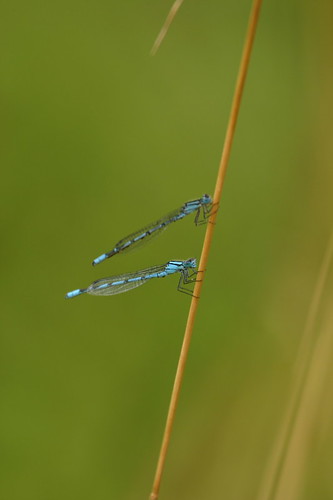
Sooner or later I’m going to run out of beautiful posterboy species but definitely not just yet.
Azure Damselflies are pretty special beasts. The males are a piercing blue and the females a slightly less predator attention grabbing green, but for me the amazing thing is how slender they are. They dash around on a blur of inadequately flimsy wings with chopper pilot bravado, and at any moment I almost expect them to simply break apart with the effort of it all.
I filmed a large group of perhaps twenty or so pairs laying their eggs (ovipositing) in tandem. Each male clasped to a female’s thorax as she dipped the tip of her abdomen below the pond’s surface, leaving a single egg with each splash. Apparently they prefer to oviposit ‘en masse’ as a defense strategy, employing the same technique as other tasty looking creatures by presenting a confusingly large number of individuals.
So, options paralysis, the ‘slacker’ affliction which means that when you’re presented with a multitude of choices you inevitably choose none, clearly works to some species’ advantage elsewhere in the animal kingdom.
Fly Agaric (Amanita muscaria)
August 27, 2010 by

Fly Agaric (Amanita muscaria)
The classic toadstool, and as such surely familiar to all through it’s numerous references in popular culture.
Whether its peeking out of the undergrowth beneath fairies and elves in book illustrations, or dancing around in Disney’s Fantasia or even appearing as a playable character in Nintendo’s Super Mario Brothers games, it highly likely you’ve seen it before, or rather, you’ve seen a representation of it before, but in truth, it’s actually not that hard to spot in the wild, particularly over the next few months, here in the UK.
Its quite a cosmopolitan species, most frequently found alongside birch trees but also with pine and spruce, so you should be able to find favourable habitat without too much difficulty.

Group of young A. muscaria
They start off as lumpy little white buttons then, as they swell, the white membrane splits and the familiar rich, shiny, red shows through.
As the toadstool grows, the membrane fragments and becomes widely scattered across the cap. It’s not very strongly attached though, and can be washed off in the the Autumn rain. This can lead to it being mistaken for other edible species of Amanita in Southern Europe, but there’s nothing quite like it in this country.
No one seems absolutely sure where the name Fly Agaric comes from but one school of thought is that it used to be used as an insecticide, another is that a peculiar quirk of its hallucinogenic properties led users to believe they were able to fly. My personal favourite though is also connected to its hallucinogenic properties as it was believed that madness or even divine possession was a result of a fly entering a persons ear.
Whimsy aside, its a pretty breathtaking species and I highly recommend it as my species of the day.


 Twitter
 Flickr
 Delicious