April 18, 2026

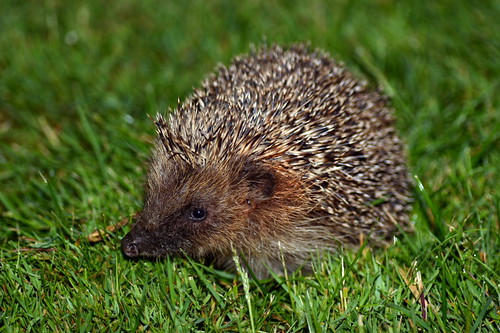
European Hedgehog (Erinaceus europaeus)

Hedgehog

Hedgehog (Erinaceus europaeus)

Like foxes, I’ve seen many more of these in urban areas than in my current rural habitat. I’d generally assumed that the local abundance of cover and lack of street lighting was to blame for my lack of recent sightings and in the area where I now live, this is probably is indeed the case, but I was rather dismayed to discover that in 2007 this familiar species of my childhood in Bristol, joined yesterday’s similarly ubiquitous species, the Common Toad, on the at risk register for flora and fauna – the UK Biodiversity Action Plan.

Habitat loss is a major threat for the modern urban Ms Tiggywinkle and it’s principally connected to the recent trend for tidy gardens. It often used to be the case that even the most fastidious of gardeners used to leave more unkempt areas to encourage wildlife and allow a bit of variety into their otherwise carefully managed plots. My Grandfather had an area about a quarter of the size of his more formal garden, which was fondly referred to as ‘the jungle’ and was filled with the truly interesting things, certainly from my perspective. This wild area was screened by trees and never mown, so was one of my earliest invertebrate hunting grounds. In fact long after my tree house fell into disrepair, the richness at the bottom end of the food chain and the general seclusion of this area, meant that it took some time for Grandpa to finally discover why he was suddenly seeing so many foxes. In fact, they’d dug a substantial earth under an old gnarled apple tree and raised a family without anyone noticing.

Without these wild urban areas, species like the Hedgehog, which have pretty meager requirements, have nowhere to forage or hibernate and so sadly their numbers decline pretty quickly. There is hope though. Maybe now that TV programs like Springwatch seem to be more popular than the garden makeover variety, it will raise people’s awareness about the impact of eradicating their own tiny ‘jungles’ which give a vital foothold to some of our most valuable and exciting garden visitors. As a matter of fact the sound of mating hedgehogs is certainly quite an experience. Leaving aside the old joke: “How do hedgehogs make love? Carefully” they do make an unearthly racket which sounds as though it’s coming from a much larger and infinitely fiercer animal.

So gardeners here’s a few wildlife gardening tips:

  • Why not leave your lawn a bit longer in places to attract pollinating insects like bees, beetles, moths and butterflies?
  • Why bother to strimmer-blitz all the far flung corners behind the shed or compost bins when you could leave them to their own devices and allow nature to move in?
  • Pile all the Autumn leaves up somewhere suitably salubrious and you could even have a traditional Hedgehog hibernation station.
  • Leave a sheet of corrugated iron in a quiet, sunny spot and you could be giving a home to Slow-worms.
  • Piles of pruned branches, logs or rocks in a quieter part of the garden make welcome habitats for everyone from Dunnocks to Frogs and Toads.

And remember the vast majority of this mob are pretty formidable predators, who’ll undoubtedly earn their keep farther down the food chain.

Most importantly though, once you’ve let the wild into your life, it’s vital for you to take a little time to appreciate it. Sitting quietly on a log, sipping tea and watching the birds, or taking a close up look at the insects attracted to your flowers, whether cultivated or wild,  or even just lying on the grass with your eyes closed, listening to the rustling, buzzing twittering sounds all around you, is more or less guaranteed to put a smile on your face.
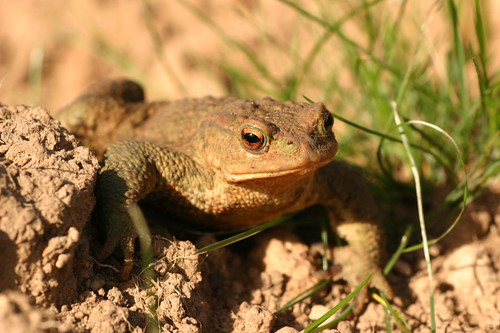
Common Toad (Bufo bufo)

Common Toad (Bufo bufo)

There’s something about the way Toads look at you. No wonder they were considered to be witches familiars. Along with Cats and Owls, they project a general impression of knowing-ness, like they’ve seen it all before “Just let me be on my way monkey boy, you silly evolutionary newcomer.

We’re lucky enough to always have a few of these around the garden. It’s a very old house, and I’m a big fan of leaving rock and log piles liberally dotted around the place, so they have plenty of habitat and prey. Although principally nocturnal, they’re pretty frequent encountered whilst lifting a log or large stone, and depending on the weather conditions thay have the most amazing range of colours. During a dryer spell they tend to be an olive or yellowish green, whereas during damper conditions, they’re often a much darker brown, almost black.

Incidentally, the category I’ve placed Bufo bufo in is called Herpetofauna. This doesn’t directly refer to conventional taxonomy, encompassing as it does, the classes of Reptilia, snakes, turtles, lizards and their kin and Amphibia to which toads belong along with frogs and another favourite order of mine, the newts.

“Herpetology offers benefits to humanity in the study of the role of amphibians and reptiles in global ecology, especially because amphibians are often very sensitive to environmental changes, offering a visible warning to humans that significant changes are taking place.”

Quoth Wikipedia

So it seems particularly fitting as a ‘one a day’ during International Year of Biodiversity.

Joe perfects his tattooing tec…

Joe perfects his tattooing technique http://twitpic.com/2i38x4

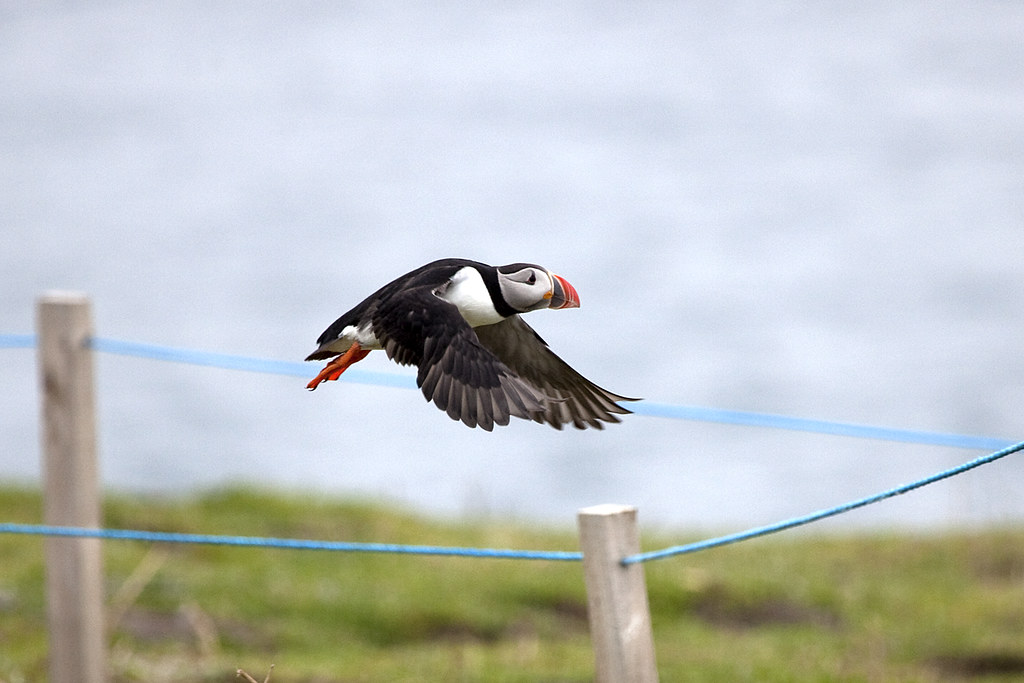
Atlantic Puffin (Fratercula arctica)

Today’s species is usually a big crowd pleaser. I’ve seen them a few times on Ynys Môn (Anglesey), both on a boat trip to the aptly named Puffin Island near Baumarris, and at the fantastic RSPB reserve at South Stack, but it’s been very difficult to get close enough for a decent picture even with my 100-400mm lens.

This year we fulfilled an ambition of mine to visit the Farne Islands and arrived just in time for the Puffins, and many other birds, to be busying themselves with nesting. Many of the other birds choose to nest on the high cliffs around the island of Inner Farne, but these remarkable little auks use the old rabbit burrows, further back from those vertiginous drops.

I took a few pictures of them in flight, but seemed unable to get myself in the right position to find one prepared to pose for me on the ground. Until that is, I spotted another photographer who suddenly froze then very slowly advanced towards a nearby burrow. I caught his eye and he very generously hissed, “one just coming out over here” so we were both able to get some really nice close ups as the bird weighed up our potential as predators. Pretty soon s/he decided that we were safe enough, so fully emerged and waddled around to line up a decent flight path, out over the cliffs and back to the sea to feed.

Even by Northumbrian standards, the Farne Islands are a really magical place. We were luck enough to see a huge list of interesting wildlife and I even managed to take a satisfying amount of pictures of them.

Scarlet lily beetle (Lilioceris lilii)

This startlingly beautiful beetle, though only around 8mm long, is the apparently the absolute scourge of lily growers. Over the past couple of years I’ve noticed that as Summer turns to Autumn, our small patch of Solomon’s Seal (Polygonatum multiflorum) has looked pretty bare and it turns out that this is the culprit.

A native of Eurasia, and having a very limited range in this country before the 1930s, the beetle has rapidly spread Westwards since the 1980s and is formally considered a ‘garden pest’. It seems to me like another case of an invasive species exploiting an evolutionary niche, rather like the Harlequin Ladybird and Signal Crayfish though in this case it appears that the victims are garden plants. Indeed the RHS and National Biodiversity Network have joined forces to encourage people to record sightings of the ‘pest’ whilst the RHS gives details of the best methods of eradication.

Unlike the Harlequin and Signal Crayfish, so far at least, it doesn’t appear that any native British species is at particular risk, so what singles this species out? Is it the fact that the larvae cover themselves with their own excrement to deter predation or is it simply the lily eating?

Now here’s the thing: apparently the beetles are much more destructive to hybrid garden species of Lily, non-native franken-plant species themselves. So essentially, a species which is a native as nearby as the continent, is on gardeners hit lists, details of killing techniques even appearing in the Daily Mail, because it happens to eat something which looks pretty and has few natural predators.

Whilst researching the last Chrysomelid, the Green Dock Beetle a few posts back, I discovered that before the 20th Century, it wasn’t found in this country either, but there’s been no witch-hunt, presumably because it feeds on plants which many consider to be ‘weeds’.

Now I’m not totally unsympathetic, but I do wonder about the odd double standard at play. The moral of the story I suppose is that if you’re going to extend your geographical range, try not to exploit succulent, decorative, hitherto unexploited resources, else the ire of middle England be loosed upon your pretty carapace.

Oh and try not to let your young, wear their own poo.

One a Day

Hmm, now I’m prepared to admit that this may be a bit of a serious undertaking, but to celebrate the fact that this is the UNs International Year of Biodiversity, I’m going to attempt to add one species a day from my collection of natural history photographs, to the blog.

So without further ado I’ll get on with species one:

The past few nights, Aphodius …

The past few nights, Aphodius rufipes, cool little Scarabs (dung beetles), have queued up to bash their armoured heads against our windows.

Wow – Internet genius http://n…

Wow – Internet genius http://ninite.com/

http://cheltenhamfestivals.com…

http://cheltenhamfestivals.com/literature-2010/british-wildlife-photographer-of-the-year/

Meet Gastrophysa viridula

Bejewelled green beetle

Green Dock Beetle (Gastrophysa viridula)

The helpful folks over at the Beetle ID forum of Natural History Museum’s Nature Plus website, have decided that this is most likely to be a male Green Dock Beetle (Gastrophysa viridula).

As the name suggests, they feed on Dock and the closely related Sorrel and are not uncommon in a variety of habitats. Even though I’m a pretty avid insect spotter, it’s the first one I’ve seen. The fact that he was tiny, only about 4-5mm in length, may be a contributary factor, as he’s undeniably extremely eye catching with his iridescent metallic carapace.