April 18, 2026

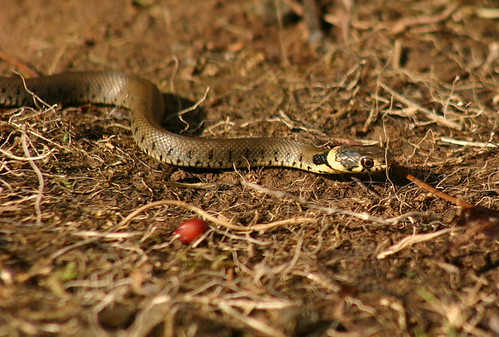
Grass Snake (Natrix natrix) – my favourite tautonym

So, tautonymy. The sharper among you will have spotted the scientific name -it shouldn’t be called the Latin name by the way as there’s a fair bit of Greek and other languages used throughout taxonomy, is the same word. Being a language spod as well as a natural history spod, well and a technology spod, hmm maybe just spod then, anyhoo, I really love tautonyms and Natrix natrix is a lovely sounding one.

On this occasion, as luck would have it, the scientific name’s derivation is from the Latin, nare ‘to swim,’ which refers to this species excellent aquatic abilities. The vast majority of a Grass Snake’s prey is amphibian and another of my species of the day tautonyms bufo bufo, features very highly on the menu – first person to give me the common name in the comment box below will win an exciting prize, probably.

This particular individual was a youngster, about 8 inches long and for some idea of scale the red blob in the foreground is a Yew berry.
Wonderful beetles! RT: @UK_Wil…

Wonderful beetles! RT: @UK_Wildlife: Stag beetles

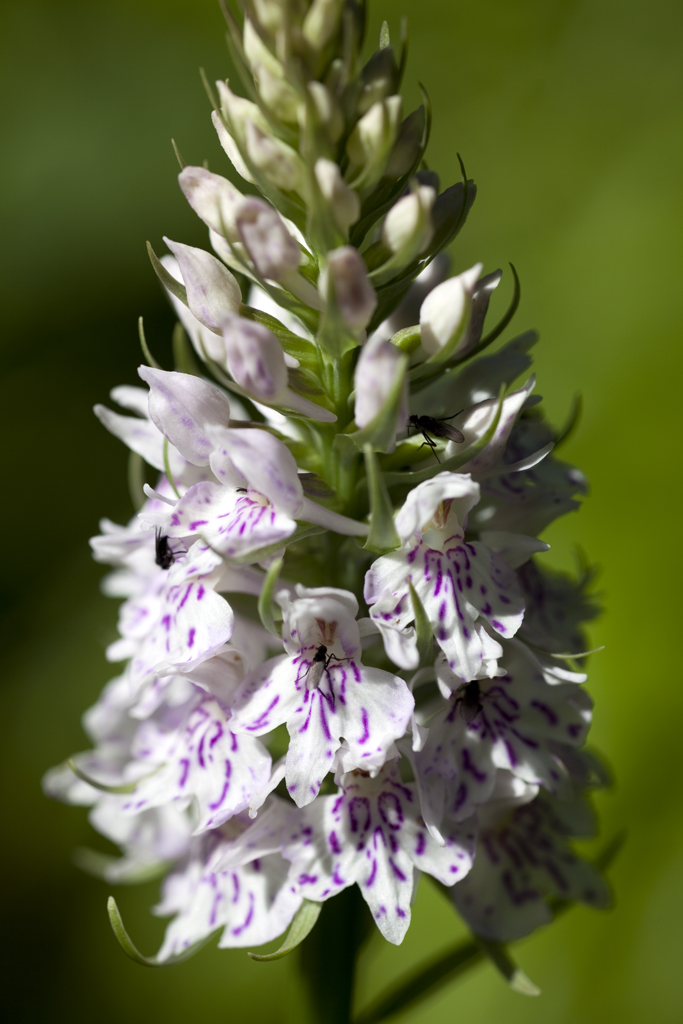
Common Spotted-orchid (Dactylorhiza fuchsii)

I always thought orchids were rare things. Growing up in this country I don’t think I saw or at least recognised one, until relatively recently but it turns out that they’re the second largest family of flowering plants.

They demonstrate a dramatic amount of adaptations and are found in every habitat except deserts and glaciers but it’s the complex relationship with their pollinators which has produced some of their more bizarre looking flowers. These highly specialised pollination mechanisms have lead to their being studied a great deal, the most famous of which being “The Various Contrivances by which Orchids are Pollinated by Insects” by a certain Charles Darwin (1862).

This species, Dactylorhiza fuchsii, is reasonably typical of the range of British species, all of which are terrestrial herbaceous perennials and as its name suggests, its one of our more common species. Indeed the sun dappled wooded area in which I took this photograph was very densely populated and there were several other similar sites nearby too.

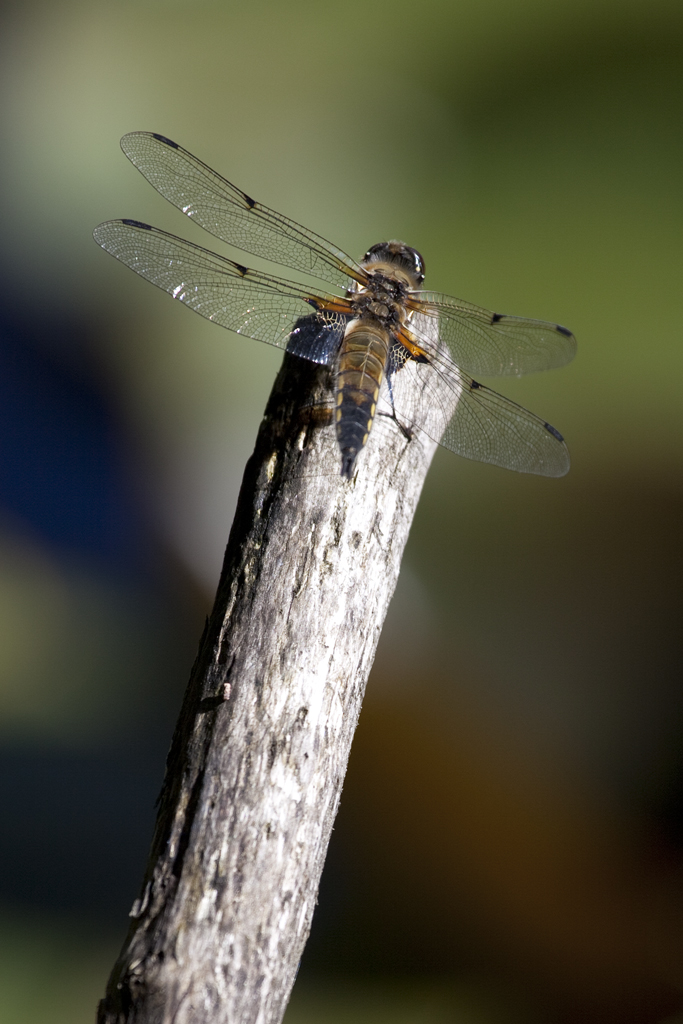
Four-spotted Chaser (Libellula quadrimaculata)

Although pretty familiar with fellow genus member Libellula depressa the Broad Bodied Chaser, which will soon feature in a fuller post, complete with HD video, this dragonfly was a new one on my species list. They’re not uncommon, but my regular dragonfly hunting ponds don’t suit them for some reason, so I was pleased to find plenty of these around a different local pond earlier this summer.

They’re pretty big insects, up to around 5cm and very active so quite easy to spot. They also have the habit of repeatedly returning to the same perch rather like Broad Bodied Chasers, which obviously helps the photographer. Unfortunately this individual kept returning to the end of the same stick in almost exactly the same position, so although I was able to get quite a few pictures, they were more or less identical. A little positional variety would have been nice and a macro lens would have been even nicer as this individual was far too intent on hunting small flies in the late afternoon sun to worry about me. Having no waders with me, I had to stick to the telephoto zoom lens as the favoured perch was a little too far into the boggy margin, but then that’s kind of why my wife bought me the zoom in the first place.

Wowsers! Always wanted to see …

Wowsers! Always wanted to see one of these in the wild. RT: @UK_Wildlife: the rather cool Water scorpion

A really fabulous damselfy spe…

A really fabulous damselfy species RT @UK_Wildlife Mating scarce emeralds, greenshank, meadow grashopper and gatekeeper

Little Owl (Athene noctua)

When we were first viewing the house we now live in, I saw a pair of Little Owls silhouetted on a branch overlooking our side garden. We’d already pretty much decided to buy the house but lets just say that owl appearance certainly didn’t harm it’s prospects.

Every year since we’ve moved in, the owls have nested in an old hollow apple tree in our neighbours’ front garden and early each summer I’ve usually seen the female teaching a youngster or two how to catch worms or insects on our front lawn. They’re partly diurnal or active during the day and also crepuscular, which means they’re particularly busy in the twilight hours either side of dawn and dusk, so fairly easy to spot during the day once you get your eye in.

They’re not a native species, but a mid 19th century introduction and unusually for an introduced species have neatly fitted into the UK ecology without discernible negative impact.

They’re pretty small owls, a little smaller in length than a Blackbird, but obviously a lot stouter and their plumage very well camouflaged particularly when sitting motionless on an old branch. However they do have favourite perches, so once you’ve spotted one in the same place a few times, it’s relatively simple to observe and perhaps even photograph them (see above). Apparently in some places they’re so accustomed to humans that they’ll boldly sit on a fence post in plain view. Ours were never so accommodating but with a bit of patience I managed to photograph one on a few occasions.

Towards the end of last summer, an injured male owl was found in the lane beyond our drive and taken to local rescue center. Sadly that was the last sighting any of us had of any Little Owls. I’m guessing the injured owl was a juvenile as I’ve normally only seen males courting our resident female in early spring. Her disappearance could simply be due to natural causes as they’re not particularly long lived creatures. I’d observed her for five years and three is the average life span so she may just have died, but because of the injured male, I just wonder whether she picked a fight with the wrong Tawny Owl, perhaps defending her chick.

Very often I’d be woken in the early hours by some very vocal sparring between Little Owls and an interloping Tawny (Strix aluco) and the larger species is known to occasionally predate the smaller, so maybe it’s not too fanciful a notion.

With a little luck, the excellent habitat around us may encourage another owl to take up residence, but for the time being the nightly hooting of amourous Tawny owls continues to go unchallenged.

Field Grasshopper (Chorthippus brunneus)

We’ve left a few patches of longer grass around the garden this year, allowing it to mature and flower and I’m convinced this is part of the reason we’ve had such a bumper year for several insect species including C Brunneus.

Creating another more accessible habitat like this, alongside the more established wilder parts has been pretty rewarding, since by their very nature, the wilder areas are left to their own devices. By contrast, areas of longer grass are easy to rummage about in and provide cover for a wide variety of creatures from grasshoppers, beetles and crickets right up to birds and Rabbits. Toddlers are also pretty fond of them.

The familiar chirping of grasshoppers has been a welcome addition to our local sound scape. A truly evocative summer sound, produced by grasshopper stridulation by which a row of minute, evenly spaced pegs on the largest joint of the hindlegs is rubbed over the more prominent veins or ribs on the forewing.

Just a short post tonight as we’ve had a long weekend of traveling, all the way to Suffolk and back for a friend’s 40th birthday. A very late night, the first we’ve spent away from Joe, and the 400 miles mean I’m more than ready for a decent night’s sleep in our own, delicious bed.

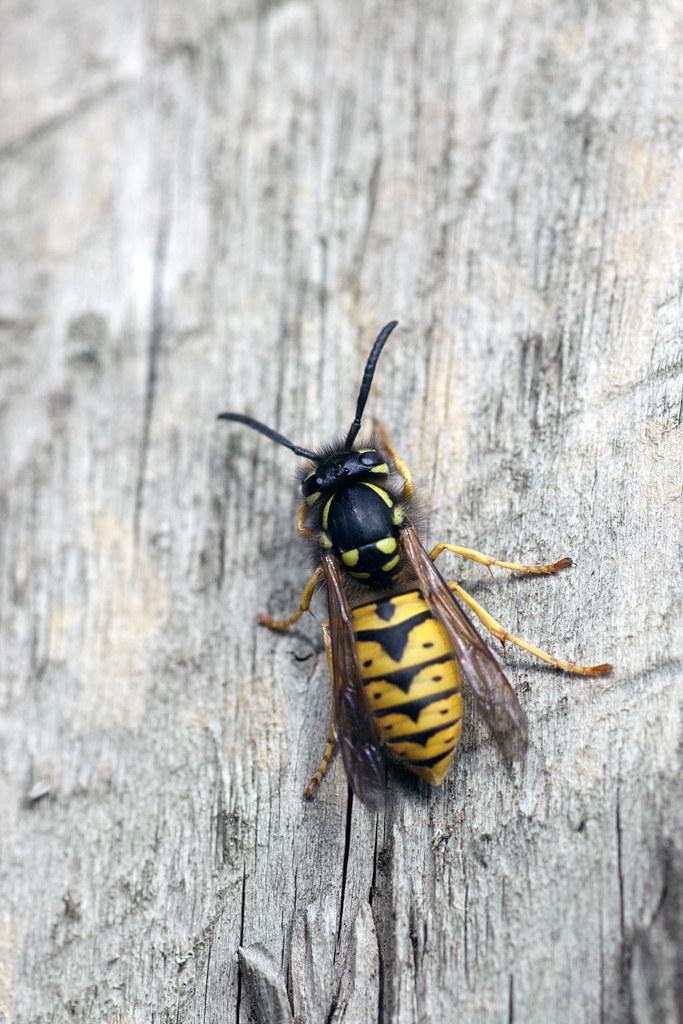
German Wasp (Vespula germanica)

Now at this time of year, I realise that this may be a risky statement but I love wasps and you should too.

The slightly aggressive, rather clumsy wasps you see in the autumn in the UK are a pale, stunted shadow of their former selves. Earlier in the year, the workers scour the area around their nest for insect prey to feed to the colony’s developing larvae. Gardeners should be particularly glad of the amount of grubs and caterpillars collected and consumed by this voracious army of sisters, for until late summer they’re all sterile female workers, born of a single queen.

All summer the workers either feed on flower nectar or ingest the juices from the meaty prey items they regurgitate to feed the larvae, in return the larvae secrete a super sweet saliva to reward the workers. Once the colony has matured, and there are no more larvae present, it’s this highly nutritious substance which they try to replace, whether it’s our food or drink, the sticky contents of our bins or the fruit in our orchards.

Ultimately, although they’re a nuisance, they’re really just a bit desperate, so waving your arms about or swatting at them just makes things worse. Try to be calm when they’re around and be observant of their habits and behaviour, then you should be able to stay sting free – you may even get to appreciate them for the interesting and beneficial insects they are.

A Twitter hiccup seems to have…

A Twitter hiccup seems to have prevented yesterdays species of the day, from being tweeted. http://ruralramblings.co.uk