#BadgerCull Minister & farmers on BBCs Countryfile clearly believe extermination the only solution.Like many Govt policies – short sighted.
Countryfile on BBC 1 doing a p…
September 19, 2010 by
Countryfile on BBC 1 doing a piece about Badgers
Common Darter (Sympetrum striolatum)
September 18, 2010 by
Continuing my series of Dragonflies and Damselfies, here’s the most often encountered species from the group of Darters.
I managed to spend a couple of hours at my local dragonfly spot early this afternoon, hoping to make the most of a brief sunny spell before the threatened rain and the continued onset of autumn. On the walk down, I was buzzed by a glorious looking Hawker racing along the hedgerow, swiftly followed by a less purposeful but equally un-photographable Darter. On arriving at the pond I set up the tripod and proceeded to be teased by a succession of Darters then cruelly mocked by a male Migrant Hawker (Aeshna mixta), who continually patrolled all around me, flatly refusing to land.
Thinking I’d try my luck away from the water as the females often only visit the pond to actually lay eggs, I wandered over to the bordering brambly scrub. I immediately spotted what I though was a female Common Blue butterfly feeding on some Ragwort and got a few shots. On closer inspection this evening and much head scratching, they’re hard to distinguish, this turned out to be a female Brown Argus (Aricia agestis) which was another new addition to my all taxa list. Excellent!
Whilst trying to photograph the future Argus, a Darter actually landed on my shoulder. Presumably to remind me what I was there for.
The first picture is a head on close up shot of a female Common Darter (S. striolatum). It turns out that this is a very useful angle for ID purposes because the ‘facial’ markings are a useful distinguishing characteristic.
The second image is of the same species, but of a pair mating in the copulation wheel position. I think this picture this is actually genuinely brilliant as I’ve not even seen them in tandem before, let alone in cop, and to be able to get a really close up shot like this is a terrific insight into a pretty alien world -for me anyway.
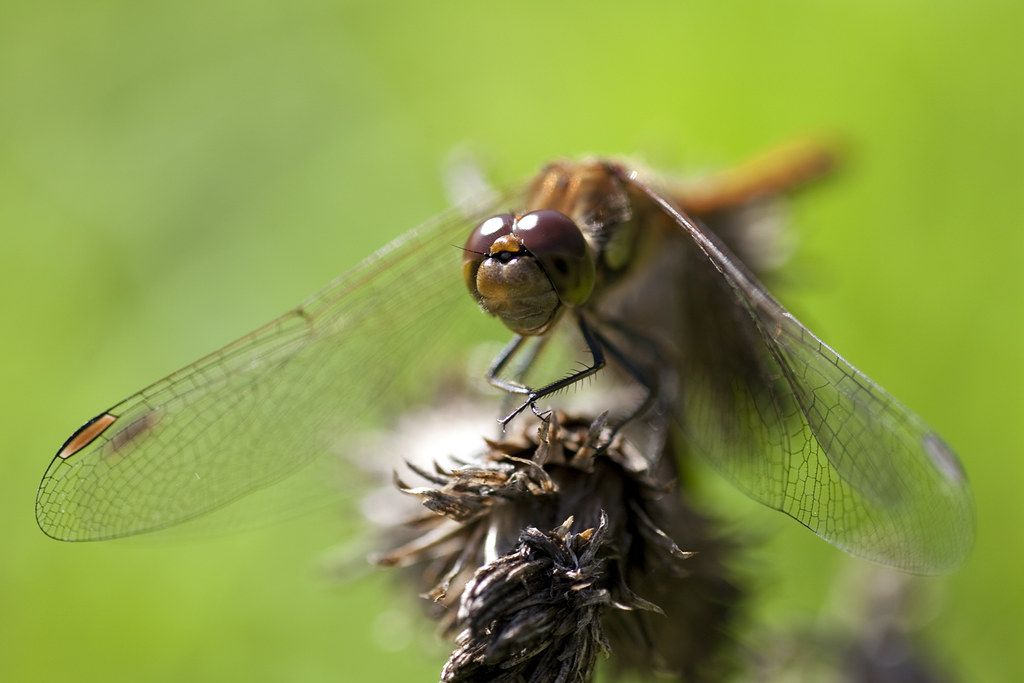
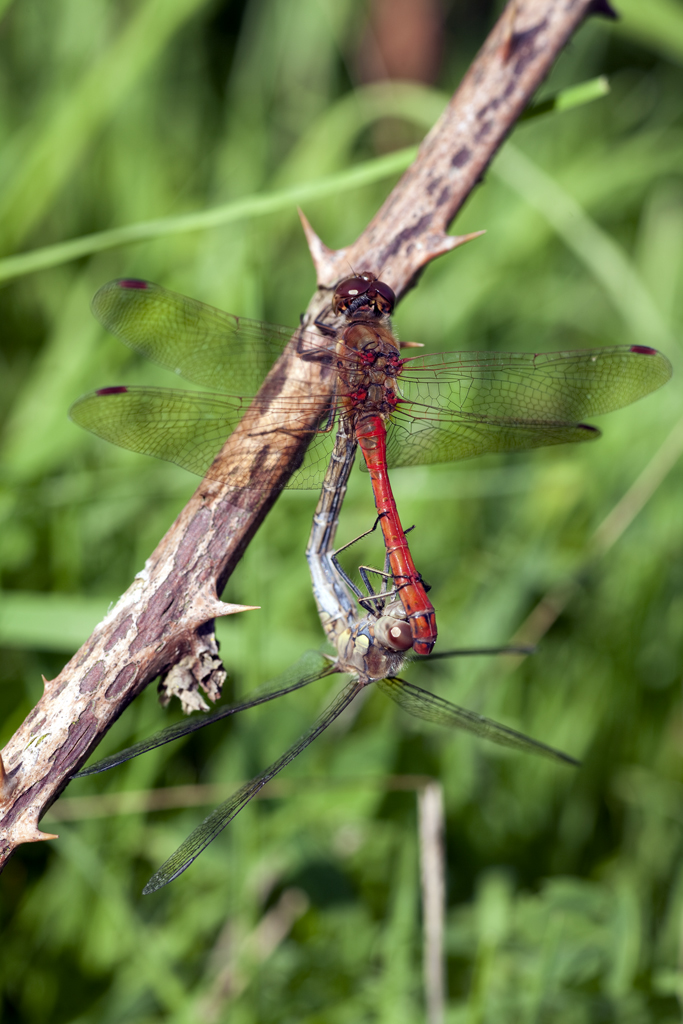
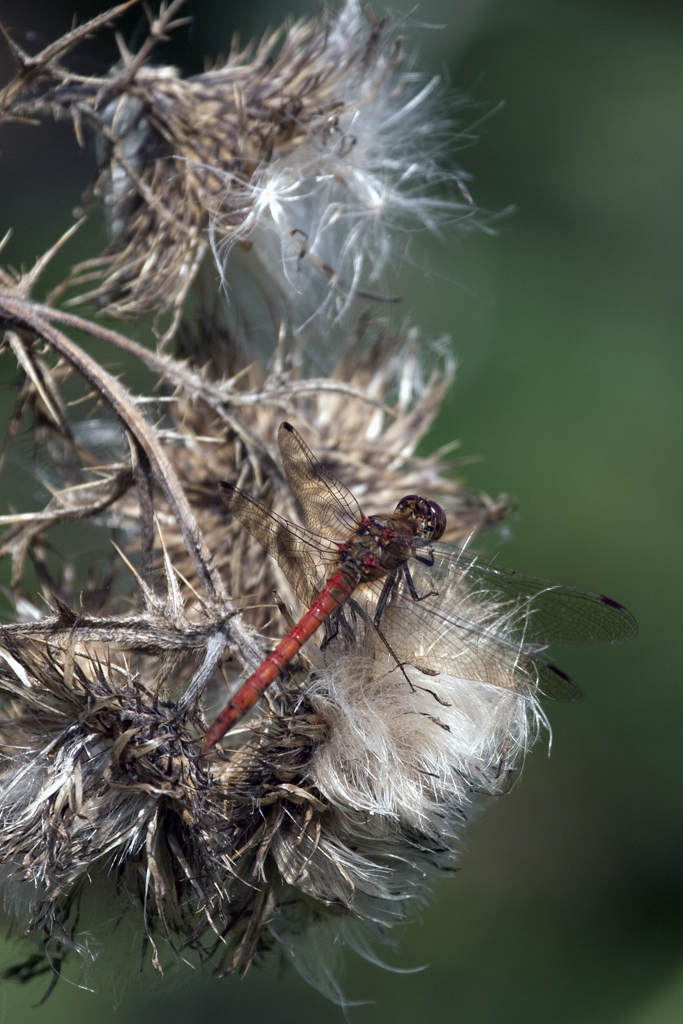
Sparrowhawk (Accipiter nisus)
September 17, 2010 by
Seasonal post this one.
At this time of year the local Sparrowhawks make the most of the glut of inexperienced and deliciously nutritious recent fledgelings. I’ve never understood why people get upset about having these exquisite predators visit their gardens. They’re usually about as close as we get to genuine tip predators, those highly evolved specialists who sit at the top of the food chain, sharing their evolutionary niche with Polar Bears, Great White Sharks and Lions. Complaining that they take birds from a busy bird table is a bit like getting uptight about Orcas eating Sea Lions from a busy beach. Species necessarily coexist and the presence of predators in an ecosystem indicates that it’s healthy. If there aren’t enough resources lower down the food chain to feed everything else, then there won’t be anything to support those predators at the top.
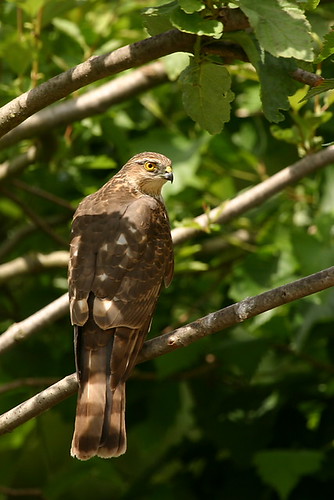
Twice this week, I’ve seen a female Sparrowhawk like the one in the photo below, catching birds in the garden. In all likelihood it’s this same female that I photographed a few years ago or at least a close relative, because they’re pretty short lived, the average lifespan being just 2.7 years.
Early on Tuesday morning I raised the bedroom blind and thought that although the weather had indeed taken an intemperate Autumnal turn, I definitely wasn’t expecting snow just yet. Large, fat, floaty flakes too. Then I noticed the alarm calls from the birds in the yew tree.
Trying to loop the blind cord round the stubby stanchion thingy, requires delicate figure of eight finesse, especially when trying to prevent a toddler getting tangled up in it. Eagerly scanning the garden for an anticipated raptor encounter hampers this. Eventually, and with the cord in a terrible mess, I spot the hawk. She’s on the lawn, covering her prey with self consciously flexed wings like a child afraid that someone’s going to copy her exam answers. All the while a sizable tree brimming with thrushes, finches and tits is venting their collective spleen, so pretty quickly she tires of the attention.
A forward lean and full smooth wing extension turns a crouch into an upward swoop.
Flight feathers flick dew from the wet grass, once, twice, three times.
The dead finch’s head metronomes each off beat, then she’s gone.
Badger Trust
September 17, 2010 by
A follow up to yesterday’s rather bleak ‘One a Day’ species.
I took out a family membership with the Badger Trust last night. I find the current government’s position very alarming and am hoping that established groups like this will be well placed to add a respected voice to the debate.
Found a nice new cycle loop to…
September 17, 2010 by
Found a nice new cycle loop today. Unfortunately all on-road, but through some really beautiful farmland. 13.5 miles in just over an hour 🙂
Stunning pix -stunning dragon …
September 16, 2010 by
Stunning pix -stunning dragon RT: @UK_Wildlife: Crockford Stream – golden ringed dragonfly and large marsh grasshopper
Badger (Meles meles)
September 16, 2010 by
In wistful mood. Had word today that a long lost friend is irretrievably so. Perhaps it’s this then that’s made me feel even more bleak about the coalition government’s proposed Badger cull.
It’s a sad turnout that in the international year of biodiversity, extermination is considered a cheap and easy solution to any problem.
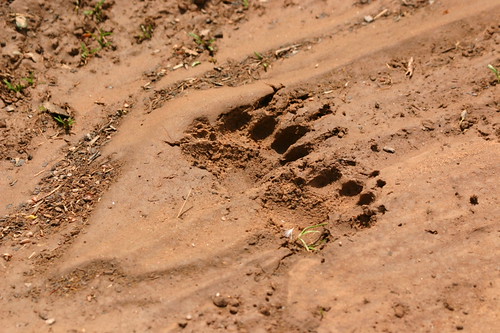
That’s enough politics, I’ll just let the picture do the talking, suffice it to say that I sincerely hope that this isn’t all that’s left of Brock in a few years time.
A toast to Desperate Dave Burns
September 16, 2010 by
A toast to Desperate Dave Burns RIP, musician and B Movie actor. Sorry it took a while.
Southern Hawker female (Aeshna…
September 16, 2010 by
Southern Hawker female (Aeshna cyanea) ovipositing, Hornets (Vespa crabro) hunting and a Small Copper (Lycaena phlaeas) – only a short walk!


 Twitter
 Flickr
 Delicious