“@UK_Wildlife: Black tailed skimmer dragonfly nymph up close ” Superb underwater shots, some really intimate views.
No less than 10 Mistle Thrushe…
October 6, 2010 by
No less than 10 Mistle Thrushes (Turdus viscivorus) have been camped out in our Yew trees or next door’s orchard for the past few weeks.
SPecies Of the Day (SPOD)
September 27, 2010 by
Well it had to happen at some point, but I’m going to have to change my self imposed rules for my One a Day posts – it’s just too much of a time commitment!
From now on it’ll be SPOD posts instead and they’ll be a bit less frequent but hopefully just as riveting 🙂
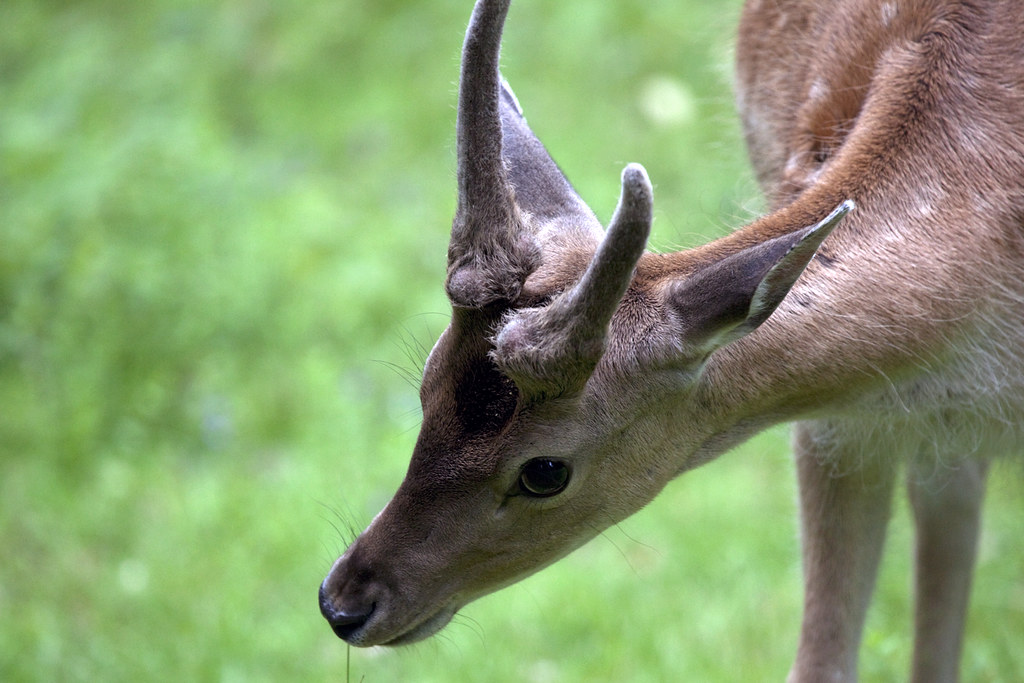
Fallow Deer (Dama dama)
September 25, 2010 by
Not really a wildlife picture this one as it was taken in a deer park in Denmark but I’m away on a ‘Stag Do’ tonight and this buck is the closest I’ve got.
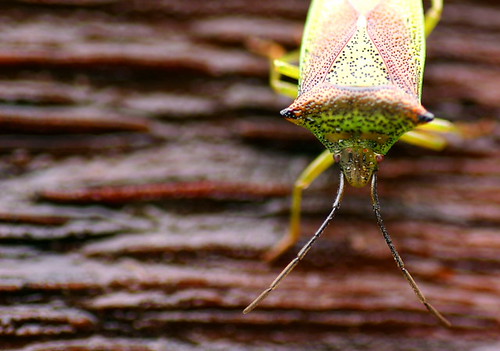
Hawthorn Shield Bug (Acanthosoma haemorrhoidale)
September 24, 2010 by
Shield bug or stink bug? Our colonial cousins across the pond favour the stink but us ‘say as you see’ Brits prefer the shape reference. Either way, we must all agree that they’re pretty much shield shaped and they do smell funny.
The funny almondy smell they exude when they feel threatened, is a cyanide compound which rather predictably does deter predators. I’ve always thought it smelled rather nice and it turns out that in Laos, Pentatomid bugs from the same family as A. haemorrhoidale are mashed up with chillies and other spices and served as a tasty side dish.
Figwort Sawfly (Tenthredo scrophulariae)
September 23, 2010 by
This is a very exciting post for me. I took these pictures 5 years ago with my first digital SLR and a newly acquired macro lens (a Tamron 90mm – which I still use) and was really pleased with the results. Looking at the yellow and black colour scheme and general shape and layout of this insect, I assumed it was a wasp, tagged the pictures as ‘parasitic wasp’ and moved on.
Writing my ‘one a day’ species posts has made me examine my archive and really learn about what I’ve captured in my pictures. Although this species superficially resembles a wasp and is in the same taxonomic order, the Hymenoptera, which includes wasps, bees and ants, its actually from the sub order Symphyta – the Sawflys.
This is exciting because it’s opened up a whole new set of creatures for me. I knew that sawfly larvae closely resembled butterfly or moth caterpillars but for some reason the adults were a total blank, a complete mystery to me. Well lets face it there’s a lot of invertebrates out there and obviously you could never recognize every individual species, but to have missed a whole sub order of the magnitude of wasps or bees was a bit of a shock!
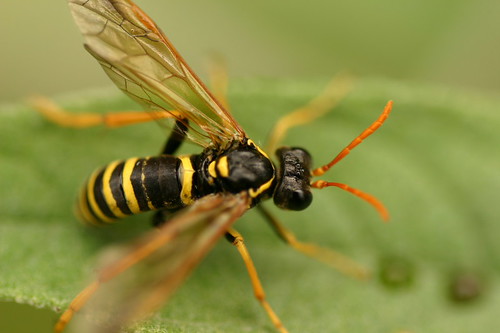
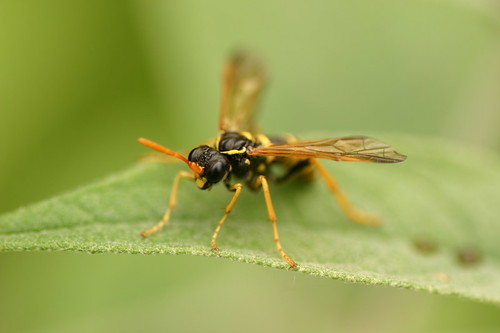

My favourite aspect of this series of photos is the clarity of the ocelli. These so called ‘simple eyes’ are the three round structures between the compound eyes. Lots of flying insects have these and as well as complimenting the compound eyes which are comparatively slow and less sensitive to light, they’re thought to play some part in flight stability and high speed orientation.
Thanks to iSpot, the Open University’s identification website, I’ve now been able to not only name something which has been on my office wall for half a decade, but also opened up an exciting new insect vista. With this in mind, a quick trip to Amazon to see what sort of guides to sawflys were available, and it turns out that the most likely candidate seems to feature T. scrophulariae on the cover:
Small world eh? Literally 🙂
Chicken of the Woods (Laetiporus sulphureus)
September 22, 2010 by
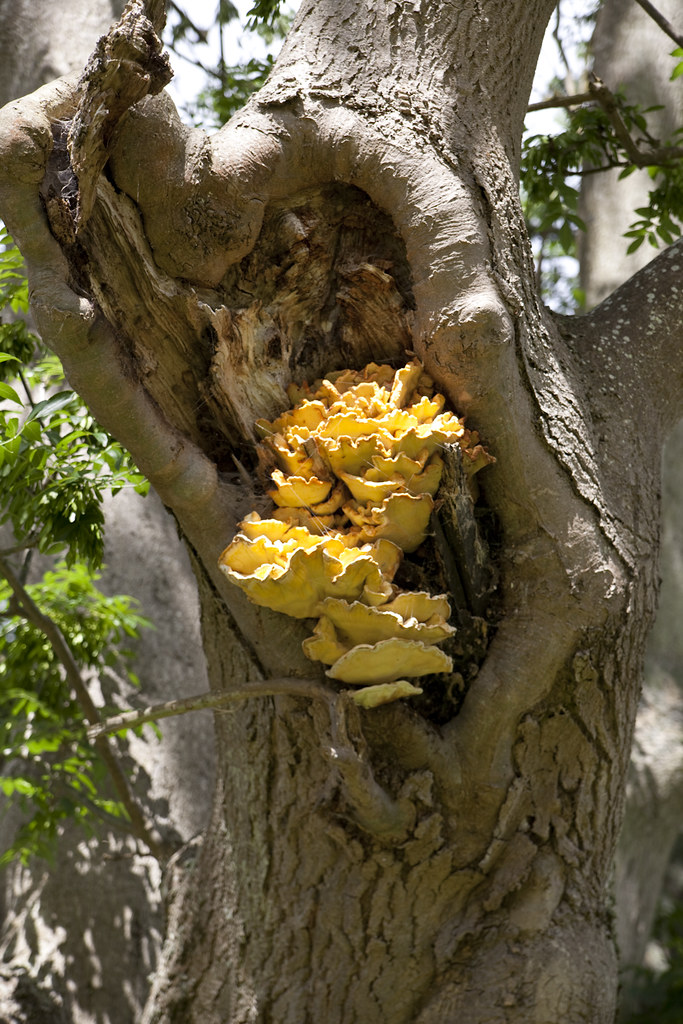
A beautiful bracket fungus with a peculiar name.
Personally, I don’t recommend you eat it this species of the day, but if you did, apparently you’d find the texture to be very similar to that of chicken. The Sulphur Polypore or Chicken of the Woods is usually considered to be an edible species, but does cause gastric problems, nausea and dizziness for a minority of people. For those who are brave enough to try it, experts recommend eating a very small piece of a young specimen before any serious consumption.
Dogwhelk (Nucella lapillus)
September 21, 2010 by
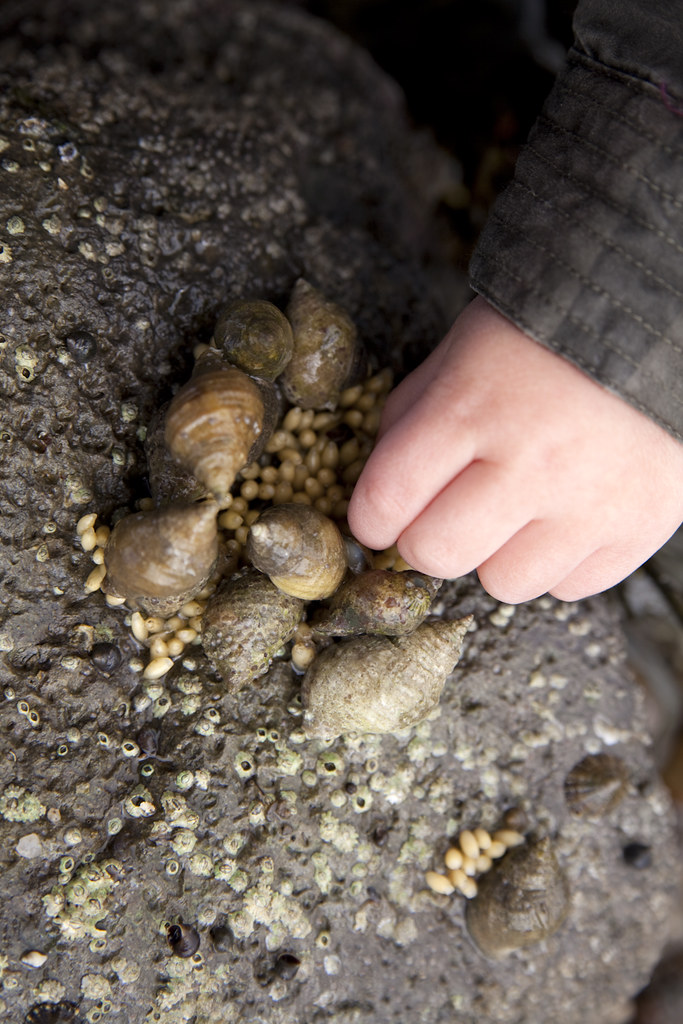
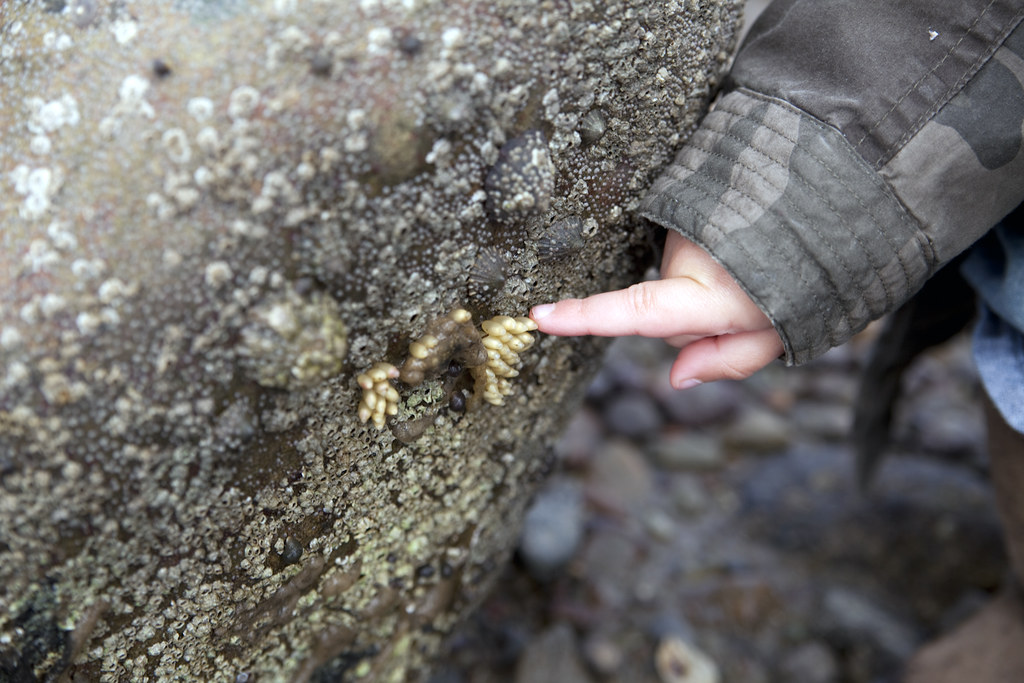
Hard to imagine any snails in the bad boy predator role isn’t it? Well I know gardeners of all persuasions will already consider them as such, but hunting and eating other living creatures? Surely not!
Well this lot certainly do. Dogwhelks are a carnivorous snail species and mainly prey on sessile (immobile or fixed) species like Barnacles or Mussels, but can even tackle smaller Limpets. They use their radula (a modified toothed tongue-like structure) to bore a hole through the prey’s shell then inject a cocktail of anaesthetic and digestive enzymes before sucking their liquefied meal back out.
They were historically used to produce a red or purple and violet dyes like their Mediterranean cousins the Murex, who’s colours were highly valued in the ancient world.
Unlike our familiar garden snails and slugs who’re hermaphrodite (possessing male and female sex organs) Dogwhelks have distinct sexes. The females lay eggs like the ones above, many of which will be infertile and used as a food source for the babies, who emerge as tiny but perfect versions of the adults.
Fortunately this species is currently undergoing something of a renaissance as it recovers from the serious effects on its reproductive capabilities, brought about by the use of certain ‘anti fouling’ paints during the 70s. These products, which discourage marine organisms from attaching themselves to the hulls of boats, caused females in the wider Dogwhelk population to grow male sex organs, which blocked their egg laying duct and caused the males’ own organs to become oversized but infertile. This phenomenon, called imposex, totally wiped them out from certain parts of the UK coastline and seriously affected their numbers elsewhere, but they seem to be recovering well now.
Common Blue (Polyommatus icarus)
September 20, 2010 by
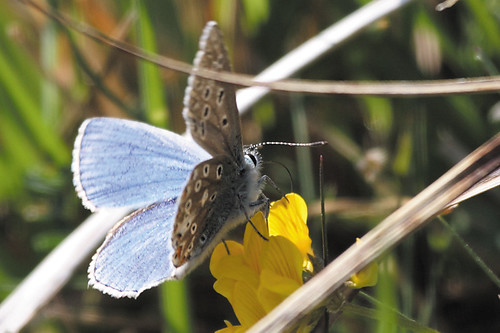
Kind of a follow up to yesterday’s species and I’d obviously have preferred a female Common Blue for comparative purposes, but beggars can’t be choosers.
P. icarus is very common throughout almost all habitats in the UK and as such is pretty familiar to even the most casual urban butterfly spotter. Along with Large and Small Whites, Small Tortoiseshells and the odd Speckled Wood, they were a staple species for my earliest forays into lepidoptery.
This male is nectaring on Bird’s-foot-trefoil (Lotus corniculatus), who’s leaves are also the main food plant for this species’ larvae or caterpillars. This is a nice illustration of the inter-relationship between insect and plant because the trefoil itself benefits by being pollinated as the butterflies feed.
Brown Argus (Aricia agestis) or Common Blue?
September 19, 2010 by


Whilst taking some exciting macros of yesterdays Dragonfly species, I was briefly distracted by this butterfly.
I thought it was a female Common Blue (Polyommatus icarus), photographed it and got back to the Dragons, but when I got home and looked at the files on the big screen I started to wonder.
There’s more to ID-ing the Brown Argus than meets the eye. Mainly because the female Common Blue isn’t blue, she’s brown, mostly. Pretty sneaky eh? Of course, this cryptic colouration is not uncommon in the bird world, females often being dowdier than males, but it’s quite unusual among butterflies, except in the Lycanidea family, the Blues. To further confuse matters, the Brown Argus is also a Lycanid and so taxonomically at least, also a ‘Blue’.
Anyway, the crux of the ID relies on some fiddly little details on which I had intended to expound, but this would be a bit esoteric without some comparative shots of a female Common Blue. I don’t have any of those. I thought I did, but funnily enough, when I came to look at them in preparation for adding them to this post, I discovered that they too were of a female Brown Argus.
Instead I refer you to Steven Cheshire who has written a superb guide to identifying the two species, which can be downloaded from his excellent site www.britishbutterflies.co.uk. I’m indebted to him for this PDF as its helped me to add another insect to my species list and that’s always a good day, despite the fact that I’ve unwittingly already seen and photographed it!


 Twitter
 Flickr
 Delicious